
FREEQUENTLY ASK QUESTIONS
Got Questions About Motorized Screens or Pergolas
Florida Living Outdoor has the answer. Below is a list of the most commonly asked question by homeowners in Florida Owners when trying to improve their outdoor spaces. Don't find it here in the FAQ. Talk with FLO. Simply fill out the chat widget.
What is your phone number?
Florida Living Outdoors’s phone number is (321)830-5660. Feel free to call anytime.
How do I schedule an appointment?
You can call the office or schedule a free 20-minute phone consultation online or schedule an appointment at the following calendar link https://floridalivingoutdoor.com/enhance-and-extend-outdoor-spaces/
Where is your office located?
Our office is located outside of Oviedo Florida, but we service the East Coast from New Smyrna Beach to Palm Coast and Central Florida from Oviedo to Mt Dora.
How do I get a quote?
You can call the office or schedule a free 20-minute phone consultation online or schedule an appointment at the following calendar link https://floridalivingoutdoor.com/enhance-and-extend-outdoor-spaces/
How long has Florida Living Outdoor been in business?
The owner of Florida Living Outdoors has been in the Outdoor Service industry for over 23 years. We are good at what we do.
What does Florida Living Outdoor do?
FL Outdoor specializes in protecting and creating smart and usable outdoor spaces that your family can enjoy.
Do you have a showroom?
No. 99.5% of its business is done in a homeowner’s backyard. We have sample demo kits and brochures to create an understanding of the product. If you move forward, we can order a life-like rendering.
Do the screens come in different shades and colors?
The housing units come in five colors: black, white, gray, bronze, and beige. The screen mesh color varies.
What is a rendering:
A rendering is a lifelike photo of your home with the desired product applied. They look real. It cool.
Is there a place where I can see motorized screens?
Yes. I’m sure we can talk to one of our clients and see theirs.
What is in an in-home consultation?
We simply need to schedule a time and one of our estimators will come out and meet with you. They will take detailed measurements and find out your wants, needs, and desires.e.
Are all motorized screens the same?
No. Motorized Screens serve different functions such as bug, solar, or storm protection.
What makes MagnaTrack so special?
That is easy. MagnaTrack uses free-floating inner tracks that release and reattach with opposite pull neodymium magnates. Combined with ballistic fiber the screens can stop a 2” x 4” traveling at fast speed.
What are the five basic components of a motorized screen?
The housing unit, track, and weight bar are the same.
How important is the screen mesh?
The screen mesh can be as simple as something for bugs or maybe you need a solar screen to block damaging UV rays. They even make screen mesh with ballistic fiber that is meant for high wind load zones.
Do I have to be home for the consultation or estimate?
Yes. You need to be there. These products are highly customizable, and we need to know your wants, needs, and desires.
Can I get a price or quote over the phone?
No. These products are highly customizable, and prices may vary depending on your needs, wants, and desires.
How much does motorized screens and pergolas cost?
The MagnaTrack system is highly customizable. Every project is different, Openings vary and the sub-strip of the unit is being attached.
How big of an opening can the motorized screen fit into?
MagnaTrack motorized screens can span 30’ and up to 20’ in height.
What is your lead time on motorized screens?
Start to finish currently they are 8 – 10 weeks.
Which is better MagnaTrack or Phantom?
Well, the simple answer is MagnaTrack Motorized screens. Not because I say so, but because MagnaTrack is not a zipper track-based system. MagnaTrack Possesses free-floating inner tracks held together by rare earth neodymium magnets. Simply put, it takes 500 Lbs. of pressure to dislodge the screen for the sidetracks. The competitors are only 30 lbs. Who needs service calls?
Do you carry hurricane screens?
Yes. We carry the Defender Series by MagnaTrack.
What type of motorized screens do you carry?
We carry the MagnaTrack Motorized screens Manufactured by Progressive Screens. The track system is the same, but the screen is configured to protect against, bugs, UV-Ray, rain, and storms.
Does the Hurricane Defender have a product approval code?
Yes. The Hurricane Defender has a product approval code. It has the Florida Product Approval #F30798
Are the Motorized Screens Miami Dade approved?
No. But the MagnaTrack Motorized Screen system meets or exceeds Miami Dade and Florida building code requirements for roll-down hurricane screens. Therefore, it can be installed in Miami-Dade.
Do install screen enclosures around pools or patios
No. We do not build or install screen enclosures around swimming pools. We specialize in protecting and creating outdoor spaces with a click of a button.
Do you replace screen pool enclosures or blowout screens.
No. We do not.
Do you repair other company’s motorize screens?
Nope. We are a MagnaTrack Dealer. We do not carry Phantom, Horizons, or Fintech. We carry the number one screen in the world. MagnaTrack.
What type of pergolas do you carry?
We carry and install Azenco-Outdoors pergolas. They are known for the louver roofs and anti-leak system aka R-blade. They also carry R-shades.
Are the Azenco-Outdoor pergolas Miami Dade approved?
Not Yet, but we are working on it. It looks like June.
What colors do the pergolas come in?
There are three colors to select from such as black, white, and grayish bronze.
How big are each pergola zone?
A louver roof zone can go 23 feet long by 15 wide. Solid roof pergolas can cover 22 feet by 22 feet.
HERE ARE A FEW THINGS THAT YOU MIGHT BE INTERESTED IN
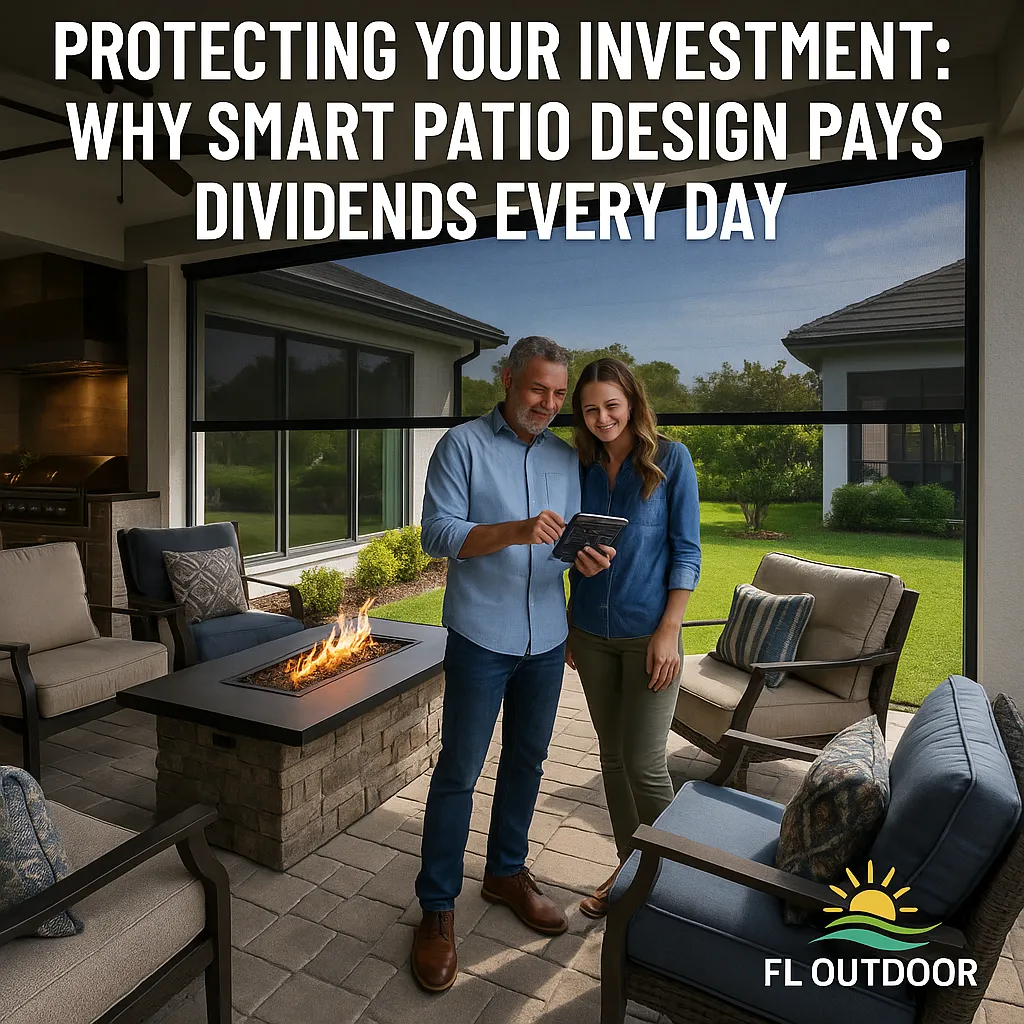
“Protecting Your Investment: Why Smart Patio Design Pays Dividends Every DayNew Blog Post
Tom and Maria didn’t need another lecture about “curb appeal.”
They needed a calculator.
They stood in their Fort Lauderdale backyard and did the math.
$42,000.
That’s what they’d poured into their outdoor space over five years. The patio, the kitchen, the fire feature. The cushions replaced every summer. The pest control bills. The storm repairs. The little purchases that felt harmless until they stacked into a mountain.
Forty-two thousand dollars. For a patio that sat mostly empty, used thirty days a year at best.
But six months ago, everything changed. They installed motorized screens. And suddenly, that same patio wasn’t draining them—it was paying them back.
Their story isn’t a one-off. It’s a warning. And it’s a roadmap. Because every homeowner eventually faces the same question:
Is your patio an asset—or a liability?
The Insurance Truth Nobody Tells You About Patios
Let’s start with what nobody wants to admit.
Your insurer looks at your patio the same way a gambler looks at a roulette wheel: risky, unpredictable, probably expensive.
That outdoor kitchen you brag about? It’s a “detached structure” in most policies. Coverage capped at 10%. If a storm takes it out, you’ll eat the difference.
But when your patio is protected—when those screens meet Miami-Dade hurricane codes—suddenly, you’re not a gambler anymore. You’re the house.
Wind mitigation credits slash Florida premiums 20–40% (floir.com). That’s $600–$1,200 saved every year on a $3,000 policy.
A single water damage claim averages $11,000 (iii.org). Avoid just one, and you’ve essentially bought your screens twice over.
Insurance isn’t about discounts. It’s about silence. Fewer claims. Fewer surprises. Lower risk. And silence, in this game, is golden.
Energy Efficiency Is a Wallet Issue, Not a Green Issue
Forget the marketing fluff. Energy savings aren’t about hugging trees. They’re about hugging your wallet.
Motorized solar screens slash cooling loads by 25–40% (energy.gov). For the average home, that’s $550–$880 saved annually. But it gets juicier.
Utilities charge triple during peak sun hours. Your patio bakes. Your AC strains. Your bill spikes. Screens block that heat before it hits, cutting peak use in half.
One Phoenix homeowner dropped 40% of peak-hour costs—over $1,100 a year. Add a $400 rebate from the utility, and they were net positive in the first year.
Scale that over twenty years with rate hikes: $30,000–$40,000 back in your pocket.
Call it what you want—sustainability, efficiency, common sense. We call it profit.
The Furniture Graveyard
Here’s the statistic no showroom shares: outdoor furniture dies 60% faster than indoor furniture.
The culprits? UV rays. Moisture. Temperature swings.
A $7,000 teak set looks timeless in the catalog. In real weather, it warps in 3–5 years. With screens? It lasts 15.
Cushions ($500–$1,000 per set) bleach and mold every summer. Protected, they last five.
Outdoor rugs ($200–$500) rot in a season. With screens, they thrive.
Tom and Maria once spent $1,500 a year on replacements. Now? $200. Screens didn’t just save money. They stopped the quiet grief of watching beautiful things decay.
Your patio can be a stage for memories—or a graveyard for furniture. Choose wisely.
The Time Tax Nobody Mentions
Here’s the cruelest cost of all: time.
3 hours storm prep.
2 hours storm cleanup.
8 hours seasonal storage.
30 minutes a week covering furniture.
A full weekend deep cleaning every year.
50 hours annually. 1,000 hours over 20 years.
That’s six months of full-time work lost to “patio chores.”
Screens erase 90% of it. That’s 900 hours returned. At $28/hour (the national median), that’s $25,000 worth of your life back.
But the truth is bigger than math. Those hours aren’t just “saved.” They’re traded up—into evenings with your kids, mornings with your spouse, weekends that feel like weekends again.
The Quality of Life ROI
This is where spreadsheets break down.
What’s the dollar value of:
A birthday party that isn’t rained out?
A quiet dinner without mosquitoes?
Holidays where nobody checks the weather app?
77% of homeowners underuse their patios (casualfurnishings.com). That’s not just wasted square footage. That’s wasted life.
Tom and Maria went from 30 days a year to 280. That’s 5,000 extra days over twenty years. At three hours each, that’s 15,000 hours of living outdoors.
Fifteen thousand hours of laughter, connection, presence. Try putting a price tag on that.
The Compound Effect
Protection multiplies value in ways homeowners rarely see:
Year 1: Energy + insurance = $1,800.
Year 2: Add furniture savings = $2,800.
Year 3: Add storm damage avoided = $4,300.
Year 5: Add property value = $7,000/year benefit.
Year 10: Add productivity + health = $10,000+/year.
By year ten, that $15,000 “expense” is returning 67% annually. Try asking Wall Street for those returns.
But the biggest compound effect isn’t money. It’s behavior. Protected patios get used. Used spaces get improved. Improved spaces build memories. And memories compound into a life well lived.
The Final Equation
So here’s the real math:
Unprotected patios = money lost, time wasted, life missed.
Protected patios = savings, safety, sanity, joy.
Tom and Maria’s payback period? 11.5 months.
But Tom said it best:
“The screens didn’t just protect our investment. They finally delivered the life we imagined.”
Your patio is either an asset or a liability. There is no middle ground.
The math is clear. The solution is proven. The only variable is you.

FLO... CREATING LUXURY OUTDOOR
Work requiring DBPR licensure in partnership with CGC1532839
MOTORIZED SCREENS
Warranty
FENCE
Horizontal Fencing
Greenwood Fence
PERGOLAS
Azenco-Outdoors
R-Blade Motorized Louver Roofs
R-Shade Insulated Roof
COMPANY INFO
About FL Outdoors
FL Outdoor News
Service Area
FAQ
IMPORTANT INFO
SERVICE AREA CENTRAL FLORIDA
Mount Dora
Longwood
Maitland
Seminole County
Windermere
Lake Nona
SERVICE AREA PALM BEACH
Boca
Boynton Beach
Delray Beach
Jupiter
SERVICE AREA BROWARD COUNTY
Fort Lauderdale
Deerfield Beach
Light House Point
Plantation
South West Ranches
SERVICE AREA VOLUSIA COUNTY
Daytona Beach
Edgewater
Orman Beach
Port Orange
SERVICE AREA FLAGLER
Beverly Beach
Bunnell
SERVICE AREA BREVARD
Merritt Island
Satellite Beach
Melbourne
Palm Bay
Vero Beach
STAY CONNECTED


Facebook
Instagram
X
LinkedIn
Youtube
TikTok
Pinterest