FREEQUENTLY ASK QUESTIONS
Got Questions About Motorized Screens or Pergolas
Florida Living Outdoor has the answer. Below is a list of the most commonly asked question by homeowners in Florida Owners when trying to improve their outdoor spaces. Don't find it here in the FAQ. Talk with FLO. Simply fill out the chat widget.
What is your phone number?
Florida Living Outdoors’s phone number is (321)830-5660. Feel free to call anytime.
How do I schedule an appointment?
You can call the office or schedule a free 20-minute phone consultation online or schedule an appointment at the following calendar link https://floridalivingoutdoor.com/enhance-and-extend-outdoor-spaces/
Where is your office located?
Our office is located outside of Oviedo Florida, but we service the East Coast from New Smyrna Beach to Palm Coast and Central Florida from Oviedo to Mt Dora.
How do I get a quote?
You can call the office or schedule a free 20-minute phone consultation online or schedule an appointment at the following calendar link https://floridalivingoutdoor.com/enhance-and-extend-outdoor-spaces/
How long has Florida Living Outdoor been in business?
The owner of Florida Living Outdoors has been in the Outdoor Service industry for over 23 years. We are good at what we do.
What does Florida Living Outdoor do?
FL Outdoor specializes in protecting and creating smart and usable outdoor spaces that your family can enjoy.
Do you have a showroom?
No. 99.5% of its business is done in a homeowner’s backyard. We have sample demo kits and brochures to create an understanding of the product. If you move forward, we can order a life-like rendering.
Do the screens come in different shades and colors?
The housing units come in five colors: black, white, gray, bronze, and beige. The screen mesh color varies.
What is a rendering:
A rendering is a lifelike photo of your home with the desired product applied. They look real. It cool.
Is there a place where I can see motorized screens?
Yes. I’m sure we can talk to one of our clients and see theirs.
What is in an in-home consultation?
We simply need to schedule a time and one of our estimators will come out and meet with you. They will take detailed measurements and find out your wants, needs, and desires.e.
Are all motorized screens the same?
No. Motorized Screens serve different functions such as bug, solar, or storm protection.
What makes MagnaTrack so special?
That is easy. MagnaTrack uses free-floating inner tracks that release and reattach with opposite pull neodymium magnates. Combined with ballistic fiber the screens can stop a 2” x 4” traveling at fast speed.
What are the five basic components of a motorized screen?
The housing unit, track, and weight bar are the same.
How important is the screen mesh?
The screen mesh can be as simple as something for bugs or maybe you need a solar screen to block damaging UV rays. They even make screen mesh with ballistic fiber that is meant for high wind load zones.
Do I have to be home for the consultation or estimate?
Yes. You need to be there. These products are highly customizable, and we need to know your wants, needs, and desires.
Can I get a price or quote over the phone?
No. These products are highly customizable, and prices may vary depending on your needs, wants, and desires.
How much does motorized screens and pergolas cost?
The MagnaTrack system is highly customizable. Every project is different, Openings vary and the sub-strip of the unit is being attached.
How big of an opening can the motorized screen fit into?
MagnaTrack motorized screens can span 30’ and up to 20’ in height.
What is your lead time on motorized screens?
Start to finish currently they are 8 – 10 weeks.
Which is better MagnaTrack or Phantom?
Well, the simple answer is MagnaTrack Motorized screens. Not because I say so, but because MagnaTrack is not a zipper track-based system. MagnaTrack Possesses free-floating inner tracks held together by rare earth neodymium magnets. Simply put, it takes 500 Lbs. of pressure to dislodge the screen for the sidetracks. The competitors are only 30 lbs. Who needs service calls?
Do you carry hurricane screens?
Yes. We carry the Defender Series by MagnaTrack.
What type of motorized screens do you carry?
We carry the MagnaTrack Motorized screens Manufactured by Progressive Screens. The track system is the same, but the screen is configured to protect against, bugs, UV-Ray, rain, and storms.
Does the Hurricane Defender have a product approval code?
Yes. The Hurricane Defender has a product approval code. It has the Florida Product Approval #F30798
Are the Motorized Screens Miami Dade approved?
No. But the MagnaTrack Motorized Screen system meets or exceeds Miami Dade and Florida building code requirements for roll-down hurricane screens. Therefore, it can be installed in Miami-Dade.
Do install screen enclosures around pools or patios
No. We do not build or install screen enclosures around swimming pools. We specialize in protecting and creating outdoor spaces with a click of a button.
Do you replace screen pool enclosures or blowout screens.
No. We do not.
Do you repair other company’s motorize screens?
Nope. We are a MagnaTrack Dealer. We do not carry Phantom, Horizons, or Fintech. We carry the number one screen in the world. MagnaTrack.
What type of pergolas do you carry?
We carry and install Azenco-Outdoors pergolas. They are known for the louver roofs and anti-leak system aka R-blade. They also carry R-shades.
Are the Azenco-Outdoor pergolas Miami Dade approved?
Not Yet, but we are working on it. It looks like June.
What colors do the pergolas come in?
There are three colors to select from such as black, white, and grayish bronze.
How big are each pergola zone?
A louver roof zone can go 23 feet long by 15 wide. Solid roof pergolas can cover 22 feet by 22 feet.
HERE ARE A FEW THINGS THAT YOU MIGHT BE INTERESTED IN
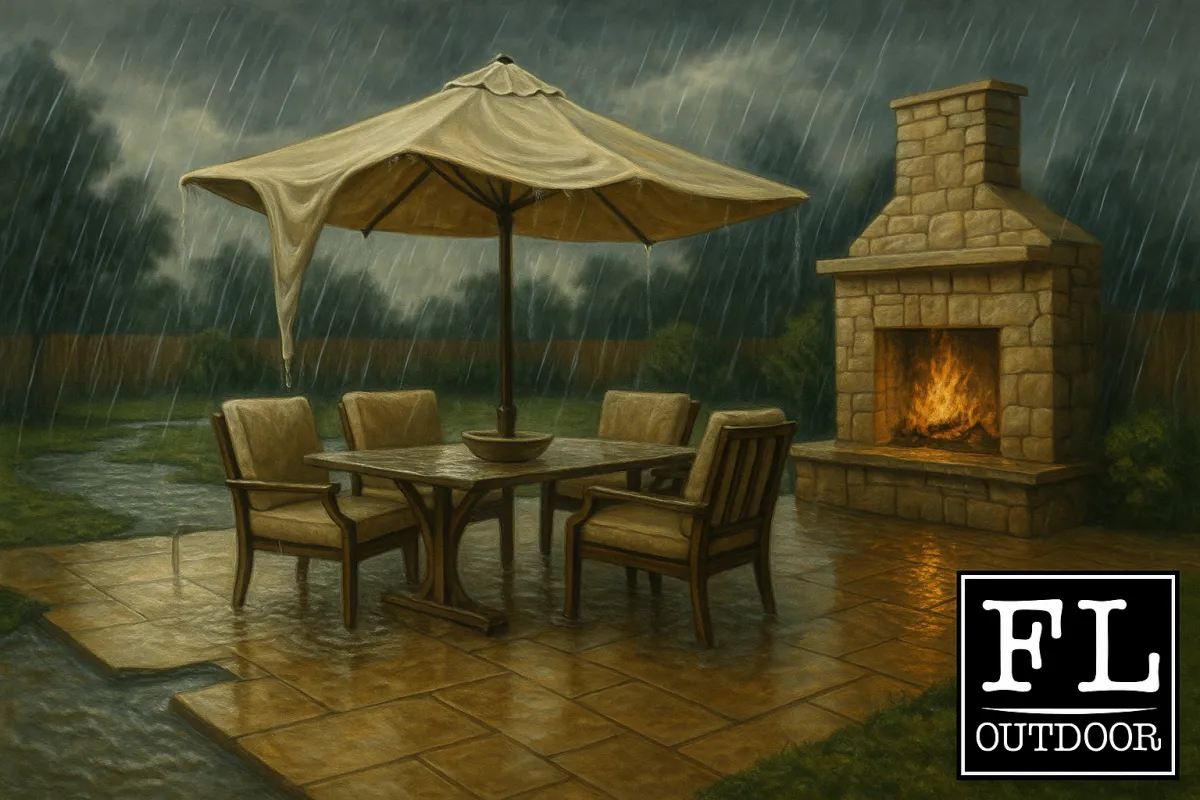
The Modern Patio Revolution, Part Two: The Patio Lies That Cost You
The Lie of the Perfect Patio
The contractor leaves.
The cushions are crisp.
The grill is gleaming.
And for a moment, you believe the lie: This patio will change everything.
Until the rain falls.
Until the sun climbs.
Until the mosquitoes arrive.
That’s when you learn the brutal truth. A patio built for a photo isn’t built for life.
The magazines never show the first puddle creeping toward your foundation. The showroom doesn’t mention that limestone turns slick as ice. And no one talks about how privacy fences that look charming in renderings won’t stop your neighbor’s gaze—or his lawnmower.
The Water Trickster
It starts innocent: a puddle in the corner. Then a rivulet across the pavers. Then, slowly, a war with your foundation.
One inch of rain on a 290-square-foot patio equals 180 gallons of water (usgs.gov). That’s a bathtub dumped onto your investment every storm.
With no drainage plan, water makes its own. Through soil. Through siding. Into basements. Into bank accounts.
Foundation repair? $10,000–$30,000. Landscaping? Another few thousand. Mold? Don’t ask.
All because no one bothered to ask the question: Where will the rain go?
The Material Mirage
That imported stone looked like luxury under showroom lights. Six months later, it’s a lawsuit waiting for rain.
The statistics aren’t flattering: darker materials push surfaces past 140°F under summer sun (energy.gov), radiating heat into homes. Tropical hardwoods demand $500–$1,000 in annual upkeep, or they decay into expensive firewood.
No wonder patios now outpace decks in new construction (nahb.org): builders learned that durability beats drama. Homeowners? Too many are still buying with their eyes, not their climate.
The Privacy Illusion
Design boards love to show pergolas. Ivy climbing. A bistro table tucked underneath.
Reality? Your patio is a stage. Your neighbors, the audience. Every meal becomes dinner theater. Every Zoom call comes with a lawnmower soundtrack.
And fixing privacy later is a triple tax: mature trees at $1,000 a piece, retrofitted motorized screens that require special posts, fences that look tacked on instead of planned.
Privacy isn’t décor. It’s dignity. Without it, your patio becomes stress, not sanctuary.
The Sunburnt Dream
At noon, the patio glows like an oven tray.
By 2 PM, the concrete scorches.
By 3 PM, you’ve retreated indoors.
Direct sunlight delivers 1,000 watts per square meter (climate.nasa.gov). On a patio, that’s like lining twenty-seven space heaters across your surface. Concrete hits 145°F. Cushions smolder. Metal chairs brand your thighs.
44% of design experts now call covered patios “essential” (icfanet.org). Umbrellas and sails? Stage props. Real shade is structural: louvers that move, awnings that think, screens that adapt.
The Bug Racket
Citronella. Zappers. Sprays. All theater.
The numbers tell the story: 195 million Americans used insect repellent in 2020—two out of three adults (cdc.gov). And yet patios remain mosquito motels, wasp colonies, ant buffets.
Professional pest control runs $400–$800 per season. Every season. Forever.
Or you build a barrier once and be done with it.
The Entertainment Lie
You built it to host. The kitchen, the firepit, the sound system.
Opening night: perfect for ninety minutes. Then guests squint in the dark. The smoke follows everyone. The chill drives people inside. By 9 PM, your patio is empty again.
37% of homeowners renovate to entertain outdoors (nar.realtor). Too many discover they built stages, not spaces.
The Storm Tax
Weather doesn’t care about your investment. Covers become sails. Pergolas catch debris. Cushions scatter like confetti.
One Florida homeowner calculated 18 hours a year spent just prepping and recovering from storms. Over 20 years? Nine work weeks gone.
Insurance often shrugs: unprotected patios equal “failure to maintain.” Translation: the bill is yours.
The Real Cost Of A Backyard Patio
That $15,000 patio? By the time you add upkeep, pest control, storm prep, furniture replacement, and inefficiency, it’s a $35,000 mistake over ten years.
And the cruelest cost isn’t financial. It’s emotional. It’s looking out at a beautiful space you almost never use.
The Protection Mandate
Every failed patio points to the same conclusion: protection is the difference between living outdoors and retreating indoors.
Drainage that tames water. Shade that beats the sun. Screens that silence the bugs. Privacy that makes a sanctuary.
Patios don’t fail because of poor taste. They fail because of poor planning.
The Path Forward
You can keep playing defense—hauling cushions, lighting citronella, watching storms undo your weekends.
Or you can join the homeowners who build smarter: who protect first, design second.
Because every unprotected patio is already counting down to its first failure.
The smartest patios of 2025 aren’t louder. They’re stronger. And they last.
Coming Next: Part Three
The Swiss Army knife of patio protection: motorized screens. From hurricane-force winds to year-round comfort, discover why this one upgrade is rewriting the future of outdoor living.

FLO... CREATING LUXURY OUTDOOR
Work requiring DBPR licensure in partnership with CGC1532839
MOTORIZED SCREENS
Warranty
FENCE
Horizontal Fencing
Greenwood Fence
PERGOLAS
Azenco-Outdoors
R-Blade Motorized Louver Roofs
R-Shade Insulated Roof
COMPANY INFO
About FL Outdoors
FL Outdoor News
Service Area
FAQ
IMPORTANT INFO
SERVICE AREA CENTRAL FLORIDA
Mount Dora
Longwood
Maitland
Seminole County
Windermere
Lake Nona
SERVICE AREA PALM BEACH
Boca
Boynton Beach
Delray Beach
Jupiter
SERVICE AREA BROWARD COUNTY
Fort Lauderdale
Deerfield Beach
Light House Point
Plantation
South West Ranches
SERVICE AREA VOLUSIA COUNTY
Daytona Beach
Edgewater
Orman Beach
Port Orange
SERVICE AREA FLAGLER
Beverly Beach
Bunnell
SERVICE AREA BREVARD
Merritt Island
Satellite Beach
Melbourne
Palm Bay
Vero Beach
STAY CONNECTED


Facebook
Instagram
X
LinkedIn
Youtube
TikTok
Pinterest