FREEQUENTLY ASK QUESTIONS
Got Questions About Motorized Screens or Pergolas
Florida Living Outdoor has the answer. Below is a list of the most commonly asked question by homeowners in Florida Owners when trying to improve their outdoor spaces. Don't find it here in the FAQ. Talk with FLO. Simply fill out the chat widget.
What is your phone number?
Florida Living Outdoors’s phone number is (321)830-5660. Feel free to call anytime.
How do I schedule an appointment?
You can call the office or schedule a free 20-minute phone consultation online or schedule an appointment at the following calendar link https://floridalivingoutdoor.com/enhance-and-extend-outdoor-spaces/
Where is your office located?
Our office is located outside of Oviedo Florida, but we service the East Coast from New Smyrna Beach to Palm Coast and Central Florida from Oviedo to Mt Dora.
How do I get a quote?
You can call the office or schedule a free 20-minute phone consultation online or schedule an appointment at the following calendar link https://floridalivingoutdoor.com/enhance-and-extend-outdoor-spaces/
How long has Florida Living Outdoor been in business?
The owner of Florida Living Outdoors has been in the Outdoor Service industry for over 23 years. We are good at what we do.
What does Florida Living Outdoor do?
FL Outdoor specializes in protecting and creating smart and usable outdoor spaces that your family can enjoy.
Do you have a showroom?
No. 99.5% of its business is done in a homeowner’s backyard. We have sample demo kits and brochures to create an understanding of the product. If you move forward, we can order a life-like rendering.
Do the screens come in different shades and colors?
The housing units come in five colors: black, white, gray, bronze, and beige. The screen mesh color varies.
What is a rendering:
A rendering is a lifelike photo of your home with the desired product applied. They look real. It cool.
Is there a place where I can see motorized screens?
Yes. I’m sure we can talk to one of our clients and see theirs.
What is in an in-home consultation?
We simply need to schedule a time and one of our estimators will come out and meet with you. They will take detailed measurements and find out your wants, needs, and desires.e.
Are all motorized screens the same?
No. Motorized Screens serve different functions such as bug, solar, or storm protection.
What makes MagnaTrack so special?
That is easy. MagnaTrack uses free-floating inner tracks that release and reattach with opposite pull neodymium magnates. Combined with ballistic fiber the screens can stop a 2” x 4” traveling at fast speed.
What are the five basic components of a motorized screen?
The housing unit, track, and weight bar are the same.
How important is the screen mesh?
The screen mesh can be as simple as something for bugs or maybe you need a solar screen to block damaging UV rays. They even make screen mesh with ballistic fiber that is meant for high wind load zones.
Do I have to be home for the consultation or estimate?
Yes. You need to be there. These products are highly customizable, and we need to know your wants, needs, and desires.
Can I get a price or quote over the phone?
No. These products are highly customizable, and prices may vary depending on your needs, wants, and desires.
How much does motorized screens and pergolas cost?
The MagnaTrack system is highly customizable. Every project is different, Openings vary and the sub-strip of the unit is being attached.
How big of an opening can the motorized screen fit into?
MagnaTrack motorized screens can span 30’ and up to 20’ in height.
What is your lead time on motorized screens?
Start to finish currently they are 8 – 10 weeks.
Which is better MagnaTrack or Phantom?
Well, the simple answer is MagnaTrack Motorized screens. Not because I say so, but because MagnaTrack is not a zipper track-based system. MagnaTrack Possesses free-floating inner tracks held together by rare earth neodymium magnets. Simply put, it takes 500 Lbs. of pressure to dislodge the screen for the sidetracks. The competitors are only 30 lbs. Who needs service calls?
Do you carry hurricane screens?
Yes. We carry the Defender Series by MagnaTrack.
What type of motorized screens do you carry?
We carry the MagnaTrack Motorized screens Manufactured by Progressive Screens. The track system is the same, but the screen is configured to protect against, bugs, UV-Ray, rain, and storms.
Does the Hurricane Defender have a product approval code?
Yes. The Hurricane Defender has a product approval code. It has the Florida Product Approval #F30798
Are the Motorized Screens Miami Dade approved?
No. But the MagnaTrack Motorized Screen system meets or exceeds Miami Dade and Florida building code requirements for roll-down hurricane screens. Therefore, it can be installed in Miami-Dade.
Do install screen enclosures around pools or patios
No. We do not build or install screen enclosures around swimming pools. We specialize in protecting and creating outdoor spaces with a click of a button.
Do you replace screen pool enclosures or blowout screens.
No. We do not.
Do you repair other company’s motorize screens?
Nope. We are a MagnaTrack Dealer. We do not carry Phantom, Horizons, or Fintech. We carry the number one screen in the world. MagnaTrack.
What type of pergolas do you carry?
We carry and install Azenco-Outdoors pergolas. They are known for the louver roofs and anti-leak system aka R-blade. They also carry R-shades.
Are the Azenco-Outdoor pergolas Miami Dade approved?
Not Yet, but we are working on it. It looks like June.
What colors do the pergolas come in?
There are three colors to select from such as black, white, and grayish bronze.
How big are each pergola zone?
A louver roof zone can go 23 feet long by 15 wide. Solid roof pergolas can cover 22 feet by 22 feet.
HERE ARE A FEW THINGS THAT YOU MIGHT BE INTERESTED IN
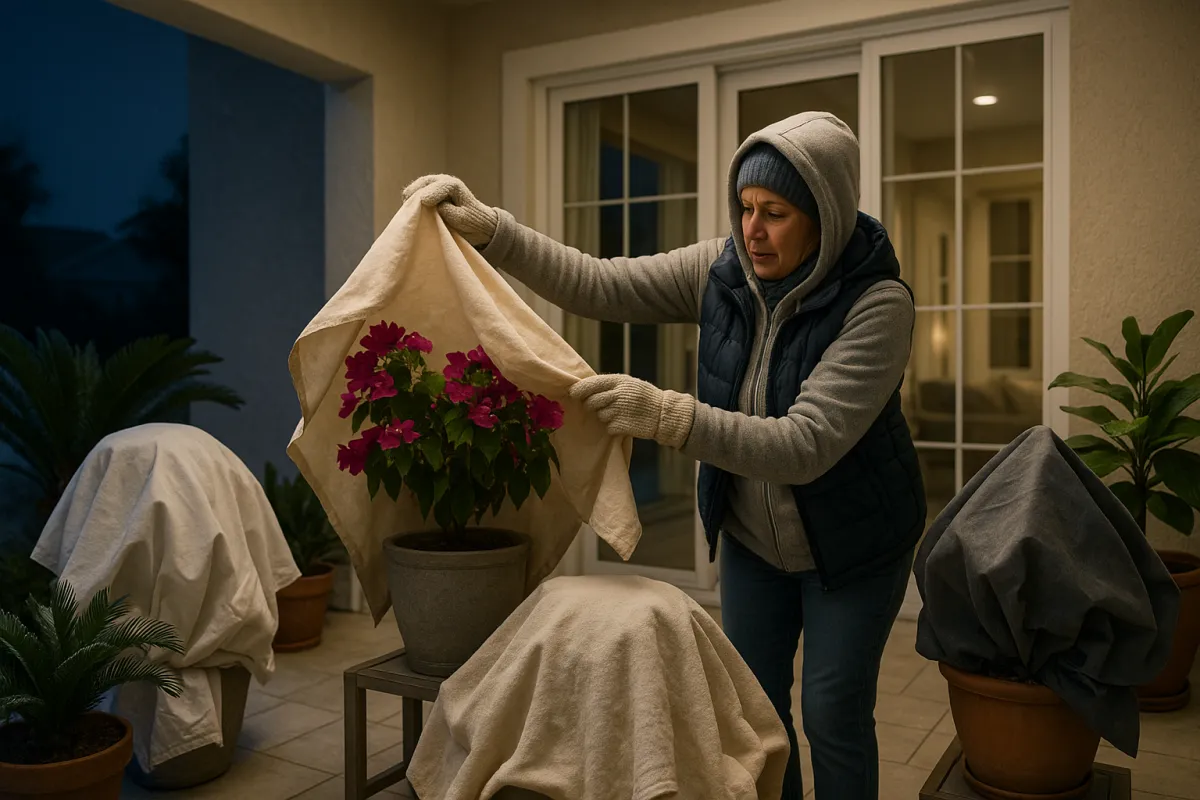
When It Freeze In Florida So Do Your Plants....
The Midnight Scramble
Eleven twenty-three PM. Tuesday in January.
You're already in pajamas. Nearly asleep. Your phone lights up with the alert you've been dreading.
Freeze Warning in Effect from 2 AM to 9 AM. Temperatures Expected to Drop to 32°F.
Your heart races.
Not again.
You throw on a hoodie. Head outside into forty-degree air. For the next hour, you're dragging sheets and blankets from the garage. Covering your prized bougainvillea—the one that took three years to establish. Wrapping your four-hundred-dollar sago palms in frost cloth. Moving potted hibiscus closer to the house. Draping tarps over your orchid collection. Hoping you've done enough.
Your neighbor's house? Dark and quiet.
Their motorized screens came down with a button press from bed. Their lanai plants are protected in a microclimate already eight to ten degrees warmer than your exposed patio.
By twelve forty-five, you're finally back in bed. Exhausted. Knowing you'll have to uncover everything by ten AM tomorrow or risk sun damage to the coverings.
There has to be a better way.
The Coastal Paradox
Here's what makes coastal Central Florida uniquely frustrating for gardeners.
The promise. Your climate is perfect for tropical landscaping. Bougainvillea. Hibiscus. Orchids. Bromeliads. Plumeria. Bird of paradise. All the gorgeous plants you see at botanical gardens. You can create year-round tropical paradise.
The reality. Flagler, Volusia, St. Johns Counties experience two to four freeze warnings every winter. Temperatures dropping to twenty-eight to thirty-five degrees. Cold enough to kill or severely damage tropical plants.
The cruel pattern. Ten months of perfection. Your tropical plants thrive. Grow beautifully. Bloom constantly. Two months of terror. January through February bring unpredictable freeze events. The aftermath. Five hundred to three thousand dollars in plant loss or damage per freeze event.
What's at Stake
Let's talk about what you stand to lose during single freeze event.
The big tickets. Sago palms: three hundred to five hundred each. Freeze damage causes frond death. Recovery takes one to two years. Severe freezes can kill them entirely.
Established bougainvillea: two hundred to four hundred plus three years growth. Dies back to roots in hard freeze. May or may not recover. Even if it does, you lose two to three years of growth.
Orchid collections: fifty to two hundred per plant. Many varieties die at thirty-five or below. No recovery. Total loss.
Bird of paradise: one hundred fifty to three hundred each. Foliage burns at thirty. Plants recover but look terrible for six-plus months.
Plumeria: eighty to two hundred each. Stem damage at thirty-three. Die-back requires cutting damaged sections. Lose one to two years of growth.
Bromeliads: thirty to eighty each. Freeze damage causes permanent scarring. Most don't recover.
The medium investments. Hibiscus: forty to eighty each. Severe die-back. Recovery possible but takes full season. Ixora: twenty-five to fifty each. Leaf burn and branch die-back. Slow recovery. Crotons: twenty to forty each. Leaves turn brown and fall off. Plants may survive but look awful for months.
The time investment. Beyond money, there's years of growth you lose. That bougainvillea that finally covered your arbor? Back to starter size. The orchid collection you've been building for five years? Decimated. The tropical garden you spent two years establishing? Needs complete replanting.
You can replace plants. You can't replace years.
The Solutions That Barely Work
You've tried everything coastal gardeners try.
Frost cloth. Two hundred to four hundred invested. Works if applied correctly. But it's eleven PM and you're trying to remember which plants are cold-hardy and which need covering. You're stumbling around in dark. Half the time you damage plants while covering them. And you'll need to uncover everything by mid-morning or risk sun damage to coverings.
Moving plants indoors for potted plants. Great in theory. Reality: you have thirty potted plants. Where are you putting them? They weigh forty to sixty pounds each. You're making fifteen trips at midnight. And they'll drop leaves indoors anyway from environment change.
Sheet and blanket method. You've raided your linen closet. Old blankets, sheets, tablecloths. Your tropical garden looks like ghost town. Sheets blow off in wind. Some plants are too large to cover effectively. And you're washing everything next day because it all got dirty and wet.
String lights and heat lamps. One hundred fifty to three hundred. Helps marginally. Burns a ton of electricity. Can cause fire hazard. Doesn't work if wind is strong.
Watering before freeze. This actually helps, but it's not complete solution. Wet soil retains heat better than dry soil. But it only provides two to three degrees of protection.
Hope and prayer. Check extended forecast obsessively. Hope freeze warnings are wrong. Plan emergency covering strategies. Still lose plants.
The Real Cost Over Time
Let's calculate true cost of freeze damage.
Conservative scenario. Minor freeze, basic landscaping. Event frequency: two freeze warnings per winter. Plant loss per event: four hundred. Replacement costs: eight hundred yearly. Ten-year cost: eight thousand.
Realistic scenario. Multiple freezes, tropical garden. Event frequency: three to four freeze warnings per winter. Plant loss per major freeze: twelve hundred. Annual replacement and recovery: two to three thousand yearly. Ten-year cost: twenty to thirty thousand.
Worst case scenario. Hard freeze, extensive landscaping. Event frequency: one to two hard freezes per decade. Catastrophic loss: five to eight thousand in single event. Plus annual minor losses: fifteen hundred yearly. Ten-year cost: twenty to thirty-five thousand.
And this doesn't include time spent covering and uncovering plants—fifty-plus hours per winter. Stress and sleep loss from midnight scrambles. Aesthetic loss. Damaged plants look terrible for months. Emotional toll. Watching years of work destroyed overnight.
What Actually Protects
Linda and Robert, Palm Coast.
They'd spent four years creating stunning tropical lanai garden. Orchids mounted on trees. Bougainvillea cascading from roof. Bird of paradise in corners. Bromeliads everywhere. Over four thousand invested plus hundreds of hours.
January twenty-twenty-four. Hard freeze. Twenty-eight degrees for four hours.
They lost sixty percent of their plants in one night. Twenty-four hundred worth. Years of growth destroyed.
December twenty-twenty-four. They contacted Florida Living Outdoor and installed MagnaTrack motorized screens.
January twenty-twenty-five. Same freeze conditions. Twenty-eight forecasted.
What happened. Eight PM: screens deployed with one button press. Eleven PM: small space heater turned on. Two AM—coldest point: outside temp twenty-eight, inside screened lanai thirty-nine. Plant damage: zero. Not a single leaf affected.
The result. Twelve thousand screen investment protected four thousand in plants. But more importantly, protected four years of growth and care.
The Science
The greenhouse effect. When you enclose your lanai with screens, you create greenhouse-like environment that naturally retains heat. Solar heat gain during day. Screens trap warmth from afternoon sun. Radiant heat retention at night. Enclosed space holds heat that would otherwise escape. Wind protection. Screens block cold wind that accelerates heat loss. Minimal heating required. Just small space heater can maintain safe temperatures.
Florida Living Outdoor specializes in both Fenetex and MagnaTrack systems—both engineered to create these protective microclimates for your tropical plants.
The math. Outside temperature: thirty-two—freeze warning. Screened lanai with no additional heat: thirty-eight to forty—marginal protection. Screened lanai with small heater: forty-two to forty-five—complete protection for most tropicals.
Critical thresholds for common coastal plants. Orchids: damage at thirty-five. Bougainvillea: damage at thirty. Hibiscus: damage at thirty-two. Bird of paradise: damage at thirty. Sago palms: damage at twenty-five.
With screens plus minimal heating, you easily maintain forty to forty-five. Safe for virtually all tropical plants.
The Flexibility
Motorized screens give you options traditional freeze protection doesn't.
Perfect weather with no freeze risk. Action: screens stay retracted. Result: full airflow, open growing environment. Plant benefit: maximum light, natural rain, optimal growth.
Freeze warning forecasted. Action: deploy screens evening before freeze. Result: gradual temperature stabilization. Plant benefit: no shock from sudden temperature change.
Hard freeze below twenty-eight. Action: deploy screens plus add small heater. Result: microclimate ten to fifteen degrees warmer than outside. Plant benefit: complete protection without individual covering.
Morning after freeze. Action: leave screens down until temps rise, then retract. Result: gradual warming prevents shock. Plant benefit: safe transition back to normal conditions.
Year-Round Benefits
Motorized screens don't just protect against cold.
Summer storm protection. Hurricane-rated screens protect plants from wind damage. Reduce rain pummeling of delicate blooms. Prevent salt spray damage during tropical storms.
UV protection. Solar screens reduce intense midday UV. Prevents leaf burn on sensitive species. Extends blooming period for orchids and other flowers.
Pest management. Physical barrier against many flying insects. Reduces pest pressure on plants. Easier to maintain healthy garden environment.
Humidity control. Enclosed space retains moisture. Reduces watering frequency. Better environment for humidity-loving tropicals.
What They Wish They'd Known
Carol, Flagler Beach: "I lost three years of bougainvillea growth in one freeze. Next year, I installed screens. That same plant has been thriving for four years since. No freeze damage. Best decision I ever made for my garden."
Thomas, New Smyrna Beach: "My orchid collection was my pride and joy. After losing eight hundred worth in single freeze, I got motorized screens. Now I sleep through freeze warnings knowing my orchids are safe."
Linda and Robert, Palm Coast: "The screens paid for themselves in two years just from avoided plant replacement costs. But honestly, the peace of mind is priceless. No more midnight panic attacks."
The Conversation
Neighbor: "How did your plants survive that freeze? Mine are destroyed."
You: "Motorized screens. One button press and my lanai stays above forty even when it's freezing outside."
Neighbor: "What about airflow? Don't plants need fresh air?"
You: "They're only enclosed during freezes. Maybe ten to fifteen nights per winter. Rest of the time, screens are retracted and plants get full sun and rain."
Neighbor: "I just lost twelve hundred in plants. What did screens cost?"
You: "Less than what you just lost. And they'll protect my plants for the next twenty years."
Your Garden Deserves Protection
You didn't spend years establishing tropical paradise to watch it die in one freeze.
You didn't invest thousands in beautiful plants to panic every January.
Your coastal garden deserves protection that lets it thrive year-round. Not just survive.
One installation. Decades of protection. Zero midnight scrambles.
Stop covering plants at midnight. Start protecting them automatically.
Ready to protect your garden? Contact Florida Living Outdoor to schedule your free consultation. We'll show you the protection possible with MagnaTrack and Fenetex motorized screen systems.
Serving Flagler, Volusia, and St. Johns Counties
P.S. The guide: "How Coastal Homeowners Save Thousands in Plants." Plant temperature thresholds. Protection strategies. Microclimate science.
FLO... CREATING LUXURY OUTDOOR
Work requiring DBPR licensure in partnership with CGC1532839
MOTORIZED SCREENS
Warranty
FENCE
Horizontal Fencing
Greenwood Fence
PERGOLAS
Azenco-Outdoors
R-Blade Motorized Louver Roofs
R-Shade Insulated Roof
COMPANY INFO
About FL Outdoors
FL Outdoor News
Service Area
FAQ
IMPORTANT INFO
SERVICE AREA CENTRAL FLORIDA
Mount Dora
Longwood
Maitland
Seminole County
Windermere
Lake Nona
SERVICE AREA PALM BEACH
Boca
Boynton Beach
Delray Beach
Jupiter
SERVICE AREA BROWARD COUNTY
Fort Lauderdale
Deerfield Beach
Light House Point
Plantation
South West Ranches
SERVICE AREA VOLUSIA COUNTY
Daytona Beach
Edgewater
Orman Beach
Port Orange
SERVICE AREA FLAGLER
Beverly Beach
Bunnell
SERVICE AREA BREVARD
Merritt Island
Satellite Beach
Melbourne
Palm Bay
Vero Beach
STAY CONNECTED


Facebook
Instagram
X
LinkedIn
Youtube
TikTok
Pinterest